Wednesday, October 19, 2011

29 - Backes Group’s Best PS Continuity


In our BlogPost 11, back in April, we introduced you to the work of Backes Graphic Productions, in Princeton, New Jersey, as the contractor for PS Magazine creative art, design, and pre-press services, by presenting their four best Front Covers as selected by the New Millennium staff of PS.

The Backes Group produced 151 issues of PS Magazine, from PS 428 (July 1988) through PS 578 (January 2001). Their contract-run, at this point in time, is second only to Will Eisner's 21 years and 227 issues. Joe Kubert, the current PS artist, is closing the gap, though, being well into his eleventh year, which will be completed with PS 711 in February of 2012.

Jack and Diane Backes were the owners, with Diane also working on page layouts. Their production manager was Mark "Sparky" Dobrowolski and the lead artist for most of those years was Scott Madsen. Other artists were Augie Scotto (who had worked with Murphy Anderson), Vic Scarpelli, and Brian Orlowski. Staff members were Saronda Stevens, Karen Mamo, and Allison Backes.

The staff at PS picked the continuity from PS 525 (August 1996), “Nothing More Important Than…,” as the best by Backes. The centerspread mini-poster is displayed above. The other six pages of the continuity are displayed in sequence, below.


We will present the Backes runner-up in our next BlogPost.

—p.e.f.

UPCOMING POSTINGS:

¶ Runner-Up PS Continuity by Backes Group.

¶ U.S. Army's Video Salute to PS Magazine

¶ Best of Perspective Instructional Communications in PS

Video: Joe Kubert at PS 60th Birthday Party

¶ A Covey of Connies: World War II to Today

Thursday, September 29, 2011

28 - Zeke Zekely's Best in PS Magazine


Zeke Zekely’s Sponsored Comics in Beverly Hills, California, held the PS contract for only six issues, PS 309 (August 1978) through PS 314 (January 1979). Zeke had obtained the contract by under-bidding Murphy Anderson, and Murphy was brought back in after Zekely’s default, resuming with PS 315 in February 1979 and continuing through PS 368 in July of 1983.

Under Zekely, the continuities were done by Dan Spiegle, who drew movie and television adaptations for Gold Key comics. “Think of titles such as Lassie,Fury, and The Misadventures of Merlin Jones,” PS Production Manager Stuart Henderson says.

The covers and two-color pages were done by Alfredo Alcala, who also drew a lot of the Conan comics for Marvel.

The New Millennium PS staff’s pick as Zekely’s Best Front Cover was on PS 309 (August 1978) showing Thor—reclining against a tree and being questioned by Connie and a soldier, and their choice as his Best Continuity was in the same issue: Famous FOD'ers [Foreign Objects Damage] of History.

The Front Cover is displayed above, the Centerspread Mini-Poster is shown below, and the Continuity follows, in order.

—p.e.f.


UPCOMING POSTINGS:

¶ A Covey of Connies: World War II to Today

¶ Best PS Continuity by Backes Group

¶ Runner-Up PS Continuity by Backes Group.

¶ Best of Perspective Instructional Communications in PS


Wednesday, September 14, 2011

27 – Early Covers Plopped Eisner and PS in Hot Water

Despite the six-year sabbatical that had been in play since the end of World War II in 1945, when Will Eisner shuffled through his memories of Connie Rodd and Joe Dope in the spring of 1951 it seemed like business as usual at the same old stand—except that the name of the stand had been changed fromArmy Motors to PS Magazine. It turned out to be an illusion, though.

The peacetime interval preceding the Korean War had seen a mass exodus of victorious, battle-hardened warriors. In the world of military logistics, where PSwas based, many management-level functions had been filled, to an increasing degree, by civilians. It took some time for the light to dawn on Eisner and the initial PS staff, but a heightened presence of socio-political sensitivities had replaced the successful raw instincts that had worked so well during the Big One.


The criticism focused on Connie and Joe, plus Joe’s foil—Fosgnoff.

There were four general hoo-ha categories: feminine attire/dimensions; unmilitary appearance; unmilitary actions; and, Poor Taste. Will batted 1.000 after PS 1 (June 1951) and continuing through PS 13 (July 1953) drawing fire from one or more directions with every one. He pleased everybody with an anthropomorphic M-41 Walker Bulldog tank on the Front Cover of PS 14 (August 1953), but fell back into his outrage streak with PS 15 (July 1953) andPS 16 (January 1954), followed by PS 20 (May 1954) and PS 26 (November 1954) registering high on the thunder-and-lightning meter.

We’re going to present sixteen Front Covers here, in numeric/chronological order, beginning above, with PS 2 (July 1951) and picking up with PS 3 (August 1951), below, leaving it to you to assign the fault category (or categories) involved. There was a lot of overlap, especially when Connie and Joe appeared on the same Front Cover.


PS 4 (September 1951), above, with Connie washing garments in a stream was a favorite with the troops, but not with the Brass.


PS 5 (October 1951), above, with dueling fantasies of Connie and Joe in a hurtling Jeep was something of a rework or an Army Motors Front Cover with Joe alone in a similar situation.


PS 6 (November 1951), above, with Connie and Joe in a close-up, under a vehicle, speaks for itself.


PS 7 (July 1952) finds Connie, Joe, and an outdoors bulletin board in the rain. Eisenshpritz, yet.


PS 8 (September 1952) positions Connie on a mountaintop, with hovering helicopters.


PS 9 (November 1952) has Joe and a buddy out of uniform amidst what might be construed as evidence of excessive firing to hit a target. The elevation of the gun reflects the issue’s (it turned out) extremely controversial article about addressing “high angle cant.” The weapons-design boys howled that “there ain’t no such thing” and the red-legged cannon-cockers firing the guns responded: “The hell you say!”


PS 10 (January 1953) insinuates the “crime” of “cannibalizing parts).


PS 11 (March 1953) calibrates the vicissitudes of Korean winters as related to alloy simian statuary.


PS 12 (May 1953) plays off the fact that there really was a segment of mountainous Korean terrain that the troops called “Jane Russell.” Donald K. Hubbard always said that this was his favorite PS Front Cover. Hubbard came on board PS as a writer in July of 1954, became managing editor in October of 1963, and succeeded James R. Kidd as Editor in January of 1983. He retired in November of 1991.


PS 13 (July 1953) is something of a sophomoric reach combining a weak pun with a common vulgarity regarding extremely dire circumstances and a missing means of propulsion.


PS 15 (October 1953) reflects a shorthand vulgarism for constructive criticism resulting from a meeting with a displeased supervisor.


PS 16 (January 1954) was a little late, but it’s the thought that counts. Merry Christmas!


PS 20 (May 1954) really offended Joe Dope’s dedicated critics. Joe was the subject of a major rehabilitation campaign that lasted several decades and included a weapons mishap (due to poor preventive maintenance) that required extensive cosmetic facial surgery. His jacket was too heavy, though, and eventually he was eased back into civilian life.


PS 26 (November 1954) had one of the better first-glance, purely graphic Front Covers. The fact that it became a classic with Safety Officers (both civilian and military) did not deter the Pecksniffian Connie critics from complaining about the ratio of attire-to-exposure.

—p.e.f.


"Oh my lord, how the world has changed!"

Time was when funny was funny. And Will was the master of the genre.

Reviewing those old covers described as "questionable"; A) feminine attire, B) unmilitary appearance or action and C) poor taste is like saying guys in the Armed Forces were never interested in Betty Grable, Lana Turner, or (you name her). Three cheers for Will and four cheers for getting by the blue-nosed censors!

—j.k.

UPCOMING POSTINGS:

¶ Best of Zeke Zekely in PS

¶ A Covey of Connies: World War II to Today

¶ Best PS Continuity by Backes Group

¶ Runner-Up PS Continuity by Backes Group.

¶ Best of Perspective Instructional Communications in PS

Monday, August 29, 2011

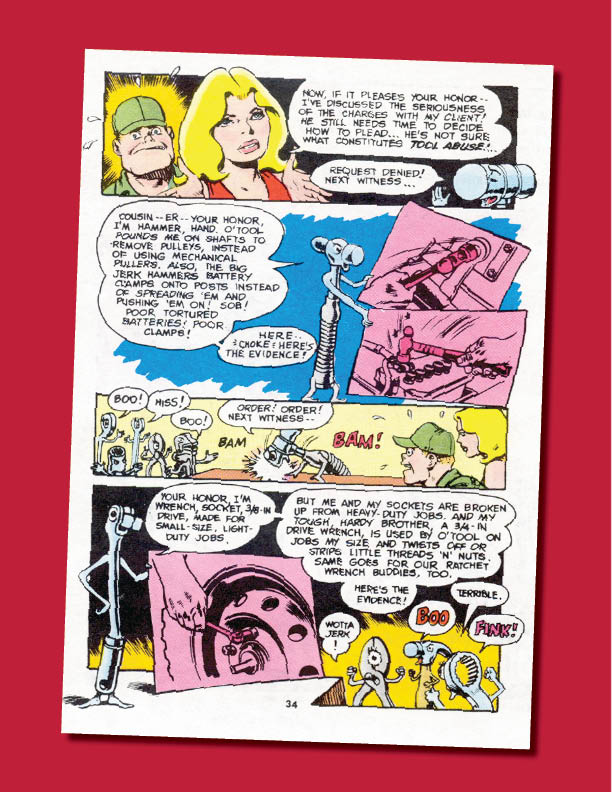
26 – Murphy Anderson’s Runner-Up "PS" Continuity


Reaction to our most recent Blogpost - 25, displaying Murphy Anderson’s best PS Continuity was so enthusiastic that we feel compelled to follow it with Murphy’s runner-up PS Continuity, as selected by the New Millennium PS Staff. He created “Tools Paradise” for PS 261, which appeared in August of 1974 during the first year that Murphy held the PS contract on his own.


After Will Eisner tongue-lashed me into finally starting on my book, Will Eisner and PS Magazine, I undertook to interview all living PS editors and as many of the long-term key artists as I could contact. Among the latter, the one with Murphy really seemed to be a breeze.


That’s because he and I were born in the same year—1926. For Murphy, it was in July. My birthday is in November. That means Murphy turned 85 last month, and I have three months to go. My colleague in this blog effort, Joe Kubert, also was born in 1926—in September.


Then, too, there is a shared Appalachian heritage. I came out of southern West Virginia and Murphy is a product of far western North Carolina, beyond Asheville.


In addition to discussing PS and his long career in comics, we chatted about family names in his Mars Hill area, tobacco allotments, relative aspects of horses versus mules as farm draft animals, and a Secret Service agent from his neighborhood whom I had met in Washington.


The funniest part of the exchange was his narrative of a youthful expedition by bicycle from Greensboro to Mars Hill—a distance of 191 miles with a concurrent altitude-gain of 1,457 feet—described with a courtly delivery sprinkled with chuckles.
—p.e.f.
UPCOMING POSTINGS:
¶ Early Covers Put Eisner, PS in Hot Water
¶ Best of Zeke Zekely in PS
¶ A Covey of Connies: World War II to Today
¶ Best PS Continuity by Backes Group

Thursday, August 18, 2011

25 – Murphy Anderson’s Best "PS" Continuity


Murphy Anderson’s PS Magazine creds included a long stint of yoeman’s efforts in Will Eisner’s shop and two years when the PS contract was in the hands of the post-Eisner group, before he won the contract in his own name in 1973, going on to produce PS 252 (November 1973) through PS 308 (July 1978).

Murphy had already established himself as a multi-talented artist in the stables of DC Comics (National Periodical Publications) in the 1960s and 1970s. Murphy was considered to be not only one of their best pencil artists but an amazingly talented inker, inking not only his own pencils, but embellishing the pencil work of others.


"The team of Curt Swan (pencils) and Murphy Anderson (inks) on Superman in the 1960s and 1970s produced the Superman 'look' that the average Baby-Boomer sees in his mind when he thinks of Superman," PS Production Manager Stuart Henderson has said. Murphy also drew Hawkman, the Flash, Batman, and virtually all of the DC characters.


Other artists in Murphy's shop included: Frank Chiramonte, Augie Scotto, Dan Zolnerowich, Creig Flessel, Craig Daniels, Howard Berman, and Murphy's son (Murphy III), wife Helen, and daughter Sophie.


I held a high degree of respect and admiration for Zolnerowich, who was much-liked, friendly, cooperative and productive. His presence in the shops of Will Eisner, the post-Eisner group, and Murphy Anderson, was a highly valued asset. He was a meticulous, steady worker whose strongpoint was technical illustration—the true heart of the PS mission—from the magazine’s very beginning and for more than 30 years. He was an even-tempered bear of a man whose presence was a pleasure. Dan began his career in the Eisner-Iger Studios in the late 1930s, shared a Fiction House background with Murphy who also started there, and racked up an array of credits with the early DC Comics where he returned after leaving Murphy.


Anderson lost the contract in July of 1978 through a low-bid award to Zeke Zekely’sSponsored Comics. Zekely’s group produced PS 309 through PS 314 before defaulting on the contract. Murphy and his group stepped back into the picture, going on to produce PS 315 (February 1979) through PS 368 (July 1983).


The New Millennium staff at PS picked The Hunt, featuring Santa Claus and his Elves (as an endangered species), as Murphy’s best PS Continuity. It appeared in PS 265 (December 1974).

—p.e.f.


UPCOMING POSTINGS:

Murphy Anderson’s Runner-Up PS Continuity

Early Covers Put Eisner, PS in Hot Water

Best of Zeke Zekely in PS

A Covey of Connies: World War II to Today

Thursday, August 11, 2011

24 – "PS Magazine" Characters and Animation


Questions regarding the use of PS Magazine characters in animation are not unusual, whenever knowledgeable sources interface with PS enthusiasts. The sad truth of the matter is that the questions far outnumber the known instances when the basic PS mission was augmented by animated film.

The first occurred in 1962 when plans were percolating for a force-wide readiness endeavor that ended up being called Operation ARM—for Army Ready Materiel. The kickoff was concurrent with the publication of PS 118 in September of 1962. (See PS 118.IFC-1, above, and PS 118.2-3, below.)

The product was a relatively short black-and-white tone-setter designed as an opening item for motivational sessions. Will Eisner produced it—under duress—kicking and screaming all the way. He said that he didn’t know anything about animation before he got involved with the project, and knew even less when he had finished it. Of course, this was ages before computerized animation, it was a labor-intensive undertaking, and his existing shop had no significant capability or inclination in that arena.


It wasn’t a bad little piece of work, but it certainly didn’t find its way to any film festivals. We picked out some opening Doom’s Day music that quickly led into a mushroom-cloud nuclear detonation and the mood was set. One problem that seemed to hang around until the last moment involved the repetitive-action loops—the tracks on tanks appeared to be running backwards, and the line of people (distant view) entering a building seemed to be coming out when it was supposed to be going in.

Will always claimed that he lost his shirt on the deal, and I’m inclined to believe him. In those days, training films were considered to fall within the responsibilities of the Signal Corps, which was not in love with animation as a communication concept, and was even less enamored of PS. The funding for the Operation ARM animation product came from the Ordnance Corps and the contract negotiation and administration was through the New York Ordnance District with some heavy handholding from the U.S. Army Maintenance Board.

Various PS staffers, over the years, have labored to preserve PS heritage as best they could, but file-retention programs, storage limitations, and four PCS (Permanent Change-of-station) moves over the years have taken their toll. Except for the one that I actually saw in the can at the preview showing, I don’t think I ever saw another copy of it. Up to this point, it’s been the big one that got away.

I have entertained hopes that some day a true PS fan with enough rank and Signal Corps roots will turn over the right rock.

But, enough already about what we can’t show you. Let me tell you what we’re gonna do.


(Frame from PS Magazine TV Promotion Spot)


Back in the late 1960s, five years or so after Operation ARM, there was a period of experimentation with black-and-white television spots prepared for release through Armed Forces television facilities. They were 16-mm, silent, clack-and-white products shipped with an accompanying sound cassette. Sound synchronization concerns were minimal. All of them that I’ve run across in the past two or three decades had managed to lose the cassette somewhere along the way—something that I suspect occurred more often than not, rather early on.

The video offered below is a 60-second, black-and-white television spot plugging PS, from 1968. You may never see another one like it!

—p.e.f.


It was a surprise for me to learn that Will did not want to get into animation with the PS characters. The reason for Will's reluctance could not have been lack of confidence or ability.

The essence of being a good cartoonist is to draw "still" pictures that give the impression of life and movement—to take a sequence, or a series of panels, and to select the actions that will allow (or inspire) the reader to fill in the missing pictures. A film or animated sequence contains each and every movement. A cartoon story or strip is much more limited and depends on a single picture for movement and credibility created by the cartoonist.

Will's capability to give life to his characters is unquestioned. So his hesitancy to get into animation must have been a business decision, not an artistic one.

—j.k.


UPCOMING POSTINGS:

Murphy Anderson’s Best PS Continuity

Best of Zeke Zekely in PS

Early Covers Put Eisner, PS in Hot Water

A Covey of Connies: World War II to Today