Monday, August 29, 2011

26 – Murphy Anderson’s Runner-Up "PS" Continuity


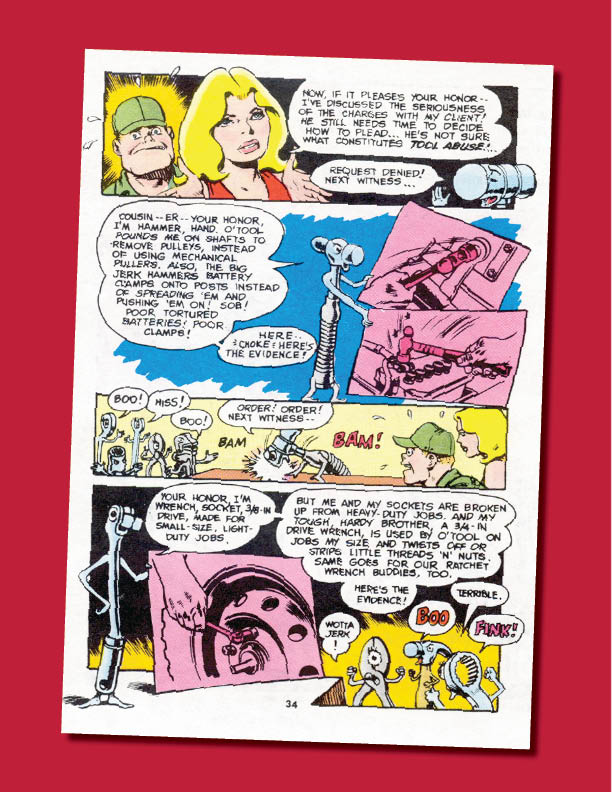
Reaction to our most recent Blogpost - 25, displaying Murphy Anderson’s best PS Continuity was so enthusiastic that we feel compelled to follow it with Murphy’s runner-up PS Continuity, as selected by the New Millennium PS Staff. He created “Tools Paradise” for PS 261, which appeared in August of 1974 during the first year that Murphy held the PS contract on his own.


After Will Eisner tongue-lashed me into finally starting on my book, Will Eisner and PS Magazine, I undertook to interview all living PS editors and as many of the long-term key artists as I could contact. Among the latter, the one with Murphy really seemed to be a breeze.


That’s because he and I were born in the same year—1926. For Murphy, it was in July. My birthday is in November. That means Murphy turned 85 last month, and I have three months to go. My colleague in this blog effort, Joe Kubert, also was born in 1926—in September.


Then, too, there is a shared Appalachian heritage. I came out of southern West Virginia and Murphy is a product of far western North Carolina, beyond Asheville.


In addition to discussing PS and his long career in comics, we chatted about family names in his Mars Hill area, tobacco allotments, relative aspects of horses versus mules as farm draft animals, and a Secret Service agent from his neighborhood whom I had met in Washington.


The funniest part of the exchange was his narrative of a youthful expedition by bicycle from Greensboro to Mars Hill—a distance of 191 miles with a concurrent altitude-gain of 1,457 feet—described with a courtly delivery sprinkled with chuckles.
—p.e.f.
UPCOMING POSTINGS:
¶ Early Covers Put Eisner, PS in Hot Water
¶ Best of Zeke Zekely in PS
¶ A Covey of Connies: World War II to Today
¶ Best PS Continuity by Backes Group

Thursday, August 18, 2011

25 – Murphy Anderson’s Best "PS" Continuity


Murphy Anderson’s PS Magazine creds included a long stint of yoeman’s efforts in Will Eisner’s shop and two years when the PS contract was in the hands of the post-Eisner group, before he won the contract in his own name in 1973, going on to produce PS 252 (November 1973) through PS 308 (July 1978).

Murphy had already established himself as a multi-talented artist in the stables of DC Comics (National Periodical Publications) in the 1960s and 1970s. Murphy was considered to be not only one of their best pencil artists but an amazingly talented inker, inking not only his own pencils, but embellishing the pencil work of others.


"The team of Curt Swan (pencils) and Murphy Anderson (inks) on Superman in the 1960s and 1970s produced the Superman 'look' that the average Baby-Boomer sees in his mind when he thinks of Superman," PS Production Manager Stuart Henderson has said. Murphy also drew Hawkman, the Flash, Batman, and virtually all of the DC characters.


Other artists in Murphy's shop included: Frank Chiramonte, Augie Scotto, Dan Zolnerowich, Creig Flessel, Craig Daniels, Howard Berman, and Murphy's son (Murphy III), wife Helen, and daughter Sophie.


I held a high degree of respect and admiration for Zolnerowich, who was much-liked, friendly, cooperative and productive. His presence in the shops of Will Eisner, the post-Eisner group, and Murphy Anderson, was a highly valued asset. He was a meticulous, steady worker whose strongpoint was technical illustration—the true heart of the PS mission—from the magazine’s very beginning and for more than 30 years. He was an even-tempered bear of a man whose presence was a pleasure. Dan began his career in the Eisner-Iger Studios in the late 1930s, shared a Fiction House background with Murphy who also started there, and racked up an array of credits with the early DC Comics where he returned after leaving Murphy.


Anderson lost the contract in July of 1978 through a low-bid award to Zeke Zekely’sSponsored Comics. Zekely’s group produced PS 309 through PS 314 before defaulting on the contract. Murphy and his group stepped back into the picture, going on to produce PS 315 (February 1979) through PS 368 (July 1983).


The New Millennium staff at PS picked The Hunt, featuring Santa Claus and his Elves (as an endangered species), as Murphy’s best PS Continuity. It appeared in PS 265 (December 1974).

—p.e.f.


UPCOMING POSTINGS:

Murphy Anderson’s Runner-Up PS Continuity

Early Covers Put Eisner, PS in Hot Water

Best of Zeke Zekely in PS

A Covey of Connies: World War II to Today

Thursday, August 11, 2011

24 – "PS Magazine" Characters and Animation


Questions regarding the use of PS Magazine characters in animation are not unusual, whenever knowledgeable sources interface with PS enthusiasts. The sad truth of the matter is that the questions far outnumber the known instances when the basic PS mission was augmented by animated film.

The first occurred in 1962 when plans were percolating for a force-wide readiness endeavor that ended up being called Operation ARM—for Army Ready Materiel. The kickoff was concurrent with the publication of PS 118 in September of 1962. (See PS 118.IFC-1, above, and PS 118.2-3, below.)

The product was a relatively short black-and-white tone-setter designed as an opening item for motivational sessions. Will Eisner produced it—under duress—kicking and screaming all the way. He said that he didn’t know anything about animation before he got involved with the project, and knew even less when he had finished it. Of course, this was ages before computerized animation, it was a labor-intensive undertaking, and his existing shop had no significant capability or inclination in that arena.


It wasn’t a bad little piece of work, but it certainly didn’t find its way to any film festivals. We picked out some opening Doom’s Day music that quickly led into a mushroom-cloud nuclear detonation and the mood was set. One problem that seemed to hang around until the last moment involved the repetitive-action loops—the tracks on tanks appeared to be running backwards, and the line of people (distant view) entering a building seemed to be coming out when it was supposed to be going in.

Will always claimed that he lost his shirt on the deal, and I’m inclined to believe him. In those days, training films were considered to fall within the responsibilities of the Signal Corps, which was not in love with animation as a communication concept, and was even less enamored of PS. The funding for the Operation ARM animation product came from the Ordnance Corps and the contract negotiation and administration was through the New York Ordnance District with some heavy handholding from the U.S. Army Maintenance Board.

Various PS staffers, over the years, have labored to preserve PS heritage as best they could, but file-retention programs, storage limitations, and four PCS (Permanent Change-of-station) moves over the years have taken their toll. Except for the one that I actually saw in the can at the preview showing, I don’t think I ever saw another copy of it. Up to this point, it’s been the big one that got away.

I have entertained hopes that some day a true PS fan with enough rank and Signal Corps roots will turn over the right rock.

But, enough already about what we can’t show you. Let me tell you what we’re gonna do.


(Frame from PS Magazine TV Promotion Spot)


Back in the late 1960s, five years or so after Operation ARM, there was a period of experimentation with black-and-white television spots prepared for release through Armed Forces television facilities. They were 16-mm, silent, clack-and-white products shipped with an accompanying sound cassette. Sound synchronization concerns were minimal. All of them that I’ve run across in the past two or three decades had managed to lose the cassette somewhere along the way—something that I suspect occurred more often than not, rather early on.

The video offered below is a 60-second, black-and-white television spot plugging PS, from 1968. You may never see another one like it!

—p.e.f.


It was a surprise for me to learn that Will did not want to get into animation with the PS characters. The reason for Will's reluctance could not have been lack of confidence or ability.

The essence of being a good cartoonist is to draw "still" pictures that give the impression of life and movement—to take a sequence, or a series of panels, and to select the actions that will allow (or inspire) the reader to fill in the missing pictures. A film or animated sequence contains each and every movement. A cartoon story or strip is much more limited and depends on a single picture for movement and credibility created by the cartoonist.

Will's capability to give life to his characters is unquestioned. So his hesitancy to get into animation must have been a business decision, not an artistic one.

—j.k.


UPCOMING POSTINGS:

Murphy Anderson’s Best PS Continuity

Best of Zeke Zekely in PS

Early Covers Put Eisner, PS in Hot Water

A Covey of Connies: World War II to Today

Wednesday, August 3, 2011

23 – "PS Magazine" Saluted "Gunsmoke"—When Both Were Young


When the world was made aware of the June 3 death of actor James Arness, at the age of 88, I had a flashback to a sun-filled, early autumn evening in 1960, sitting beside Will Eisner aboard one of the early commercial jets, on our way to San Francisco and, ultimately, Korea.


We had looked down at Manhattan when the jet circled westward and talked about Will’s abiding affection for the Big Apple, with its (then) grime and hard shell. When that conversation lagged, I had asked him which PS episodes, if any, he had really enjoyed producing. The first one that he mentioned was Gunsmoke.


At the time of that conversation, PS 93 had just come off the presses. TheGunsmoke issue, PS 81, had been a year before, in August of 1959. The television version of the adventures of U.S. Marshal Matt Dillon premiered in 1955, and the PS tip-of-the-hat appeared during the show’s fourth year of its eventual 20-year run.


Eisner said that he had been a nominal fan of William Conrad’s radio version of the Dodge City drama but ratcheted his enthusiasm up a Stetson-full of notches with the visual aspects and dialogue touches that developed with the ensemble troupe that coalesced around Arness as the central character. “Arness’s ‘Matt Dillon’ speaks in sequential-panel balloons,” Will said.


Another facet of Eisner’s enjoyment in doing the PS 81 Gunsmoke thing derived from the manner in which PS Editor James R. Kidd restrained his staff from crowding the artist during its development. The project developed from a discussion during the late stages of a pencil-dummy review conference in the late spring of 1959 in the PS offices at Raritan Arsenal in Metuchen, New Jersey—about half-way between the program’s 1955 transfer out of Aberdeen Proving Ground, in Maryland, and its next move to Fort Knox, Kentucky, in 1952.


The idea developed from a rather spontaneous exchange, but rapidly deteriorated when a couple of aggressive staffers began to pepper Eisner with specific visual notions and demands. Without restraint, they would have been more than willing to tell him how to allocate a page—plus, write the balloons before the art. Kidd dialed things down, told them to back off, and later channeled them into the task of preparing a script of technical necessities regarding the general field of hydraulics, and preventive maintenance of hydraulic equipment. Far-fetched? Not when a mal-functioning barber-chair played a key role at a critical moment in the PS-notion of a Gunsmoke dramatic episode!


Eisner’s concept for the Front Cover beautifully invoked the classic Gunsmoke opening-shot.

At one point when Joe Kubert and I were at Redstone Arsenal recently for the official U. S. Army celebration of the PS Magazine Sixtieth Anniversary, we found ourselves in the neighborhood of a giant blow-up of that cover. I was engaged in a conversation with several people, but I could hear Joe, behind me, delivering to another small group a precise analysis of what Eisner had done—and why. I hope he will append those remarks to this blogpost.


For me, the Gunsmoke Front Cover and Continuity of PS 81 present a precisely perfect melding of an essential technical message with the communication potential of imaginative sequential art.

—p.e.f.


[The cover for] PS 81 is a perfect example of the cartoonist's use of composition and color to tell his story clearly with impact. A complex illustration that Will simplified by the use of orange and red, except for the foreground gunbelt and gunbutt and the background figure—where contrasting blues and whites were applied. In this way, Will accomplished two things: he created an additional depth to the illustration and caused the reader/viewer to focus on the cover's point. The gun in the holster (handle falling apart because of lack of maintenance) and the spider-web connected to the handle (again showing lack of current maintenance). It is abundantly clear that the man in the background is about to do away with the foreground character for those obvious reasons.

The cover also contains a building, horses tied to a hitching post, a deep background with two men running, a couple of guys peeking out of the saloon door and two more guys hiding under the porch and one more behind the horses. With all this stuff to flesh out an interesting drawing, Will knew that the main point should be noticed first, and that's the way he designed the cover. Good compositions and proper graphic communication is no accident. Like Will always said, "The best cartoonist is the thinking cartoonist

—j.k.


UPCOMING POSTINGS:

¶ A Covey of Connies: World War II to Today

¶ Best of Zeke Zekely in PS

PS Characters in Animation

¶ Early Covers Put Eisner, PS in Hot Water

Sunday, July 24, 2011

22 – Army’s Grand 60th Birthday Party for PS: Part C


There can be no doubt about it. A grand time was had by all!

If you don’t believe me, look at the pictures. Everybody has a smile. Smiles here! There! Everywhere! A truly Joyous Occasion.


Look at the image above, taken by Pete Carlsson and showing his boss, Joe Kubert, in the early stages of the U.S. Army’s grand 60th Anniversary celebration of PS Magazine. Talk about ill-concealed, mirthful enjoyment!

Much of the Happy Face that I put forward throughout the pleasurable event derived from a renewed awareness that the PS operation is a respected and admired element of the Logistics Support Activity (LOGSA) headed by Colonel Robert P. “Pat” Sullivan. And, Colonel Sullivan marches under the four-star aegis of the U.S. Army Materiel Command (AMC), the overarching embodiment of a unifying logistics concept that was yet to exist in the balkanized technical terrain of the mid-Twentieth Century when PS was picking its precarious way through its first two decades of existence.

Smiles, indeed!

And, in the two-step cake-cutting sequence below, also snapped by Pete, there’s no cloud on anybody’s horizon.

From left: LOGSA Sergeant Major Timothy Shelton; Lieutenant General Dennis L. Via, Deputy Commanding General of AMC; Jonathan Pierce, Acting Editor of PS Magazine; and Colonel Sullivan, LOGSA Commander.


At this point, we were firmly convinced that Colonel Sullivan and his Sergeant Major were truly enjoying the event.


The Keynote Address was delivered by General Via.

General Via’s awards include the Defense Distinguished Service Medal; the Distinguished Service Medal with Oak Leaf Cluster; Defense Superior Service Medal; Legion of Merit with Oak Leaf Cluster; Defense Meritorious Service Medal with four Oak Leaf Clusters; Army Commendation Medal with Oak Leaf Cluster; Joint Service Achievement Medal; and the Army Achievement Medal. He is authorized to wear the Master Parachutist Badge and Army Staff Identification Badge.


KEYNOTE ADDRESS

Lieutenant General Dennis L. Via

Deputy Commanding General United States Army Materiel Command

60th Anniversary Ceremony for PS Magazine

June 27, 2011, Redstone Arsenal, Huntsville, Alabama

Good morning! What a great day to be a Soldier. Colonel Sullivan - thank you for the kind invitation to participate in today's ceremony.

I want to also welcome all of our distinguished guests - and especially the Department of the Army civilians who make PS Magazine possible. It's good to see all of you here.

Mr. Fitzgerald, I'm honored— Sir!— to meet you and join you in this great celebration. Our Army is forever indebted to you and Mr. Will Eisner for your role in establishing an incredibly valuable resource for our Soldiers and our Army.

And to Mr. Kubert, you know many of us grew up reading Sergeant Rock, Hawkman, and other DC Comics. And today, we all have the opportunity to meet the artist who brought us so much enjoyment in our younger years, and who continues to entertain and educate us with your current work on PS Magazine. Thank you for being here.

This month, June 2011, marks the 60-year anniversary of PS Magazine, The Army's Preventive Maintenance Monthly. The idea for PS Magazine was formed in April 1940 when Army Motors—a small monthly mimeographed publication on automotive maintenance was first introduced by the Quartermaster Corps.

A short time later, in May 1942, Private Will Eisner was inducted into the army. Private Eisner was already an established comic's artist with his The Spirit strip appearing in newspapers. Mr. Eisner began drawing for the Aberdeen Proving Ground, Maryland, post newspaper, and it wasn't long before the Ordnance Corps, which now owned Army Motors, recognized the potential of having Mr. Eisner join its staff, and the rest is history.


Corporal Eisner (eventually Chief Warrant Officer Eisner) initiated a graphic makeover ofArmy Motors, polishing existing characters such as Connie Rodd and Master Sergeant Half-Mast McCanick and adding Privates Joe Dope and Fogsnoff. Circulation of Army Motors shot up to 1.5 million copies monthly.

With the start of the Korean War, the army soon realized it needed a publication similar to Army Motors to promote preventive maintenance. PS, The Preventive Maintenance Monthly, would be the name of the new publication. The army awarded a contract to Mr. Eisner to design and draw what would come to be popularly known as PS Magazine—one of the oldest and most successful publications using "sequential art" as an educational tool to present information in short, clearly-written, highly-focused text and illustrations, the magazine illustrated proper maintenance methods with a comic book-style art form that has proven to be very effective for six decades.

As the Deputy Commanding General of the U.S. Army Material Command, I'm proud to say, the magazine's main character, MSG Half-Mast, is still in uniform even though his tour of duty began during WWII. He and his counter-part, Connie Rodd, still encourage Soldiers to practice preventive maintenance on their vehicles, weapons, and equipment. His famous question – “Would you stake your life . . . right now . . . on the condition of your equipment?” – is as relevant today as it has ever been.

For 60 years, mechanics, supply clerks, and a host of other Soldiers who operate the Army's equipment have used PS Magazine to stay up-to-date with changes to Army technical publications, repair parts, national stock numbers, and maintenance and supply policy. In every motor pool, and at every army post, camp, and station throughout the world, you're likely to see copies of PS Magazine in the office, posted on a wall, or being used at the workbench. The characters and themes in PS Magazine have changed in appearance over the years to reflect war scenarios and changes within the Army and society at large. However, while our equipment has evolved tremendously over the past 60 years, the need to properly maintain that equipment has not. Corrosion, metal fatigue, sand and mud, and simple wear and tear continue to take a toll on Army equipment. Finding and fixing these problems when they are still faults remains the most economical way to keep equipment combat ready for our Soldiers. PS Magazine's dedicated promotion of preventive maintenance will continue to play a significant role in the future.

Today, the magazine's writers, including the PS Magazine Office at the Tank and Automotive Command (TACOM) in Warren, Michigan, visit units regularly at installations across the world to keep in touch with Soldier concerns, pick up article ideas, and discover solutions to maintenance and supply issues. We are now a decade into the Twenty-First Century, and Half-Mast now has a Facebook page as well. As always, he keeps Soldiers up-to-date on late-breaking hot topics, articles that will be appearing in the next issue, and when the newest issue has been posted on the magazine's home page for viewing.

As we begin the next decade, we look forward to what PS Magazine may become as you apply technological advances to better illustrate technical art and to make the magazine as fully available electronically as it is in print. We can be assured that as history and the Army's demands continually change, PS Magazine will be at the forefront of the Soldier's need for supply and preventive maintenance issues.

The writers and the artists of PS Magazine are a team that has put together a 60-year winning streak. Not many teams can boast of that kind of record... Not even the great football teams here in Alabama.

Again, PS Magazine – Congratulations on your 60th Anniversary . . . and best wishes for much continued success.

Army Strong!


Welcoming Remarks were presented by Colonel Sullivan, above.

Colonel Sullivan’s awards and decorations include the Bronze Star Medal (one Oak Leaf Cluster); the Meritorious Service Medal (five Oak Leaf clusters); the Joint Service Commendation Medal; the Army Commendation Medal (three Oak Leaf Clusters); Army Achievement Medal (two Oak leaf Clusters; Master Parachutist Badge; Parachute Rigger Badge; and other service awards. He is authorized to wear the Australian, Canadian, and German Parachutist wings.

WELCOMING REMARKS

Colonel Robert P. “Pat” Sullivan

Commander, Logistics Support Activity (LOGSA)

PS Magazine 60th Anniversary Celebration

June 27, 2011, Redstone Arsenal, Huntsville, Alabama

Good morning: Lieutenant General Via; Mr. Rogers, Civilian Aide to the Secretary of the Army; Mr. Taylor, President of the Huntsville-Madison AUSA Chapter; distinguished guests; LOGSA team; and fans of PS Magazine.

PS Magazine's first issue was published in June 1951. In the first two years the magazine functioned with one editor and its editorial staff. And now, here we are 60 years later celebrating not only the publication of PS but, even more importantly, the incredible dedication and commitment of those pioneers and currently serving professionals who have created an enduring maintenance capability that has outlasted any other Army program of instruction or technical manual.

Today we will hear remarks from two icons in the comics industry: Paul E. Fitzgerald, the first managing editor of the magazine: and Mr. Joe Kubert, current artist for PS Magazine.

We are also honored to have joining us, Lieutenant General Dennis Via, who even though he is the longest serving active duty member here today, his thirty years only represent half a lifetime to Half-Mast, Connie Rodd and the crew.

We are honored by the presence of these leaders.

So today we'll hear a great deal about the legacy of the magazine and great accomplishments over the years. And that is essential to ensure we sustain the character and identity of this great training guide.

But before I relinquish the podium, I didn't want to lose sight of the team we have today who diligently work to carry on the cutting edge task of a previous generation. The 11-person staff of PS Magazine represents over 160 years with the magazine and over 238 years of government service. I ask that this team led by Jon Pierce, acting editor, stand so that the audience may recognize you for your contributions.

Thank you.

So let's enjoy this opportunity to celebrate the past and the incredible promise for PSmagazine as it has served Soldiers past and present and will serve future generations of America's greatest treasure.


‘Twas a most lovely and lively affair . . . the proprieties were observed at all times . . . and inevitably with a smile and a twinkle! (The “signing” photos and those of General Via and Colonel Sullivan were taken by Clay Fitzgerald.)

—p.e.f.


UPCOMING POSTINGS:

A Covey of Connies: World War II to Today

Eisner Saluted Gunsmoke in PS

Best of Zeke Zekely in PS

PS Characters in Animation